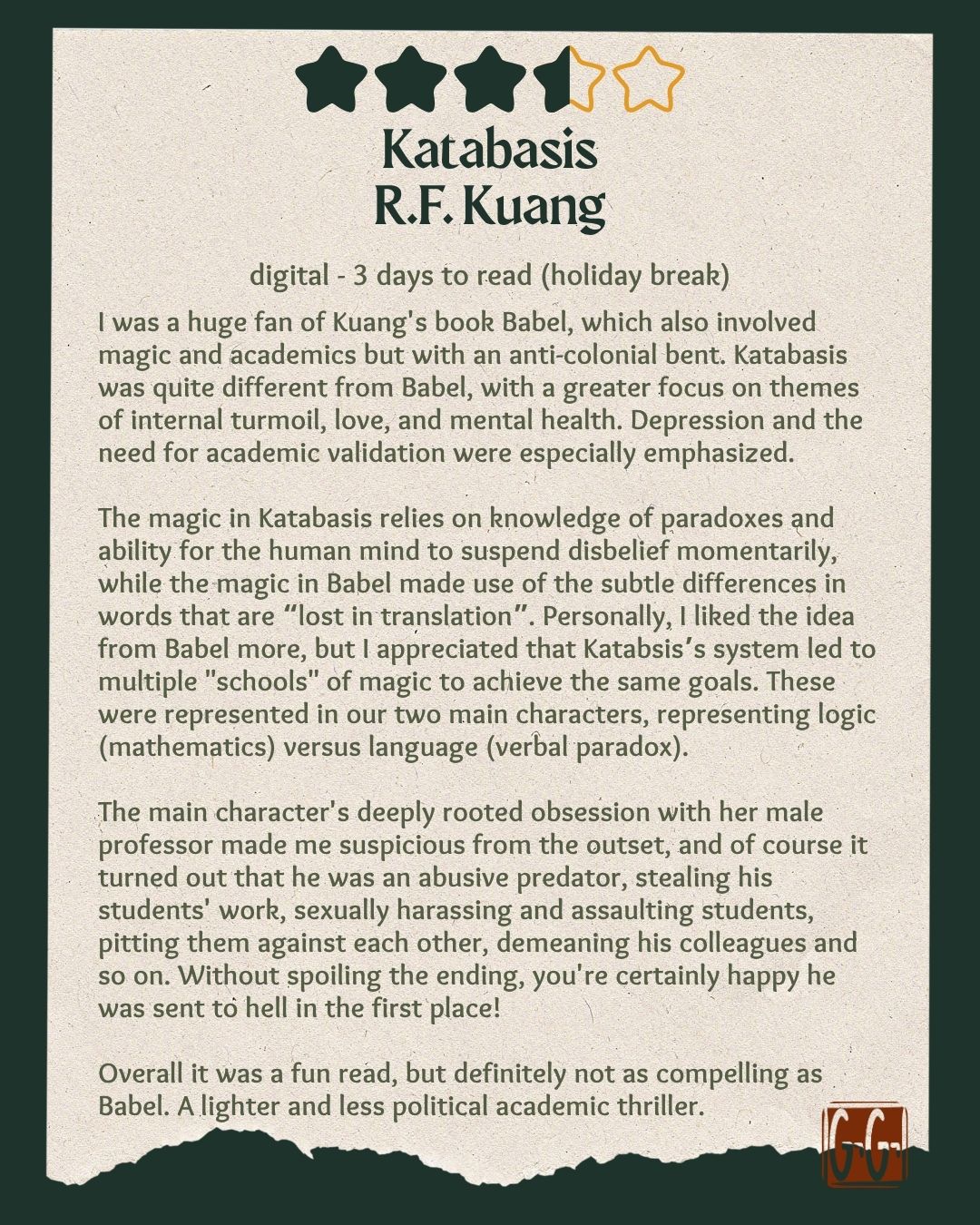
Katabasis
by R.F. Kuang
TL;DR : an academic thriller page turner with a villain who definitely deserves to be in hell
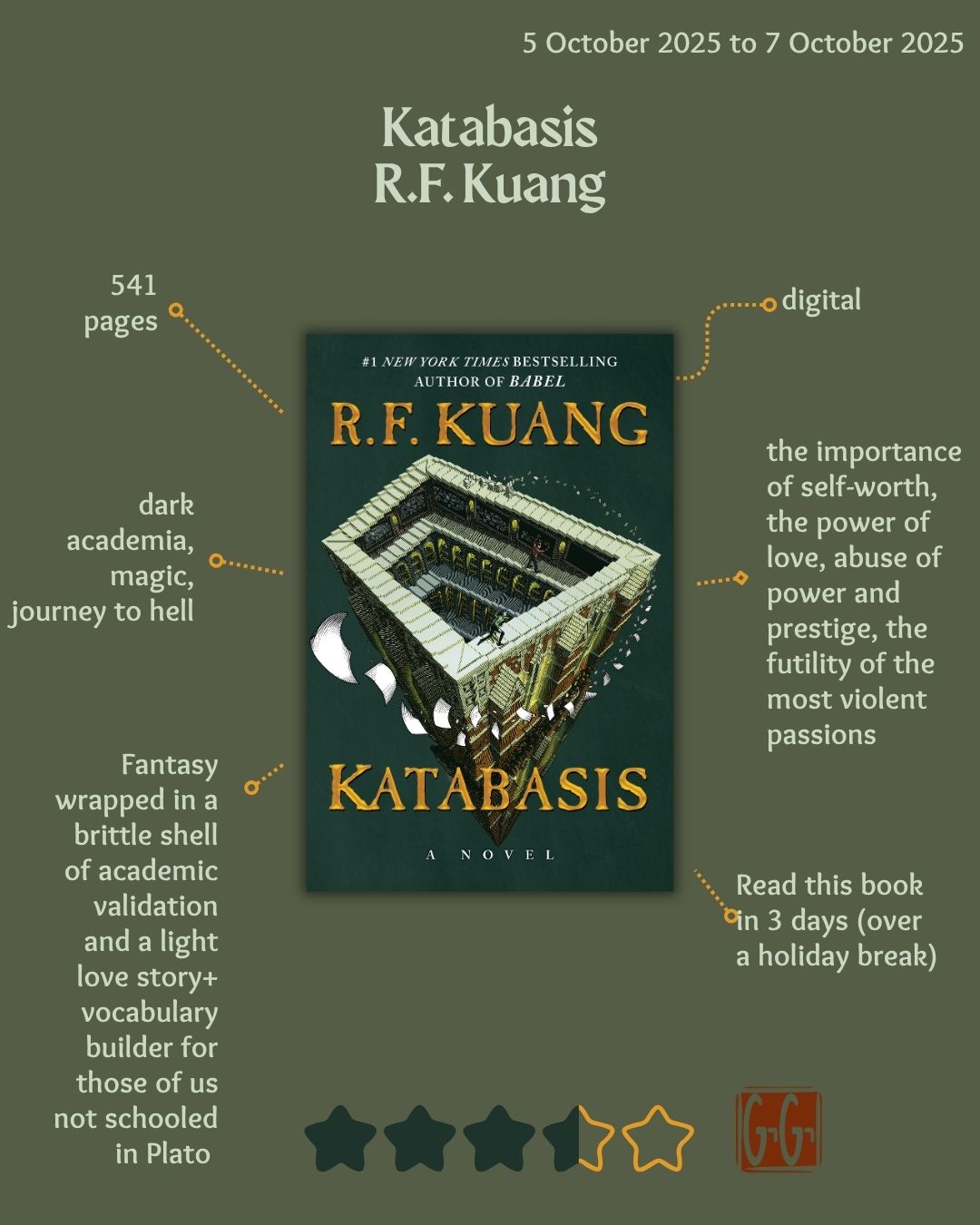
What I loved
As someone who grew up constantly searching for praise by being a great student, our main character Alice was familiar to me. She’s hardworking to the point of making herself sick. She loves her research, but her need to be exceptional hurts her. I felt pretty much the same way when I was in grad school, and I could relate to a lot of her character flaws. I wanted to root for her even as I knew she was making terrible decisions left and right.
The story itself is also fun and fastastical, as the students (Alice and Peter) go through challenges in each of the unique realms of hell. It was definitely fun to see Kuang’s ideas of how each ring of hell would be represented for grad students.
What I questioned
Alice pushes away everyone who could help her (not that I’ve ever done that cough cough) once she enters school, and she persists despite her professor’s atrocious behaviors and expectations. I suppose this is the place where Alice started to lose me, although I could understand how someone with her tunnel vision could overlook everything that should have been red alarm bells. So while I was reading, I found myself judging her a bit, until she finally looks for help. She goes to the only other female professor in her department to tell her that Professor Grimes had tried to assault her. Suddenly, as the female professor tells her that “oh, but you knew the rumors about him and you went into his group anyway!”, I was disgusted with myself. I had totally fallen into the same narrative. If the rumors about the professor were so common, why was he still teaching? Why should a young grad student, who has known nothing but academia, be expected to know to avoid an incredibly influential, career-making professor? And why was the feamle professor, instead of trying to help Alice, simply gloating about how Alice’s “one of the boys” behavior and dismissive attitude towards the feminist cause? If she herself were a true feminist, would she not take this opportunity to help a fellow woman? Although a bit lost in the overall plot of the story, I feel that Kuang’s insertion of this subplot through Alice’s flashbacks makes a point that needs to be emphasized again and again: the predator should always bear all blame, never the victim. I was honestly so glad she blew this man up by the time we got to the scene.
Alice persisted through sexual harassment, but before that she had experience just general harassment through unreasonable work hours, academic theft, and overall poor treatment. It’s tempting to assume this is exaggeration, but I have 5 or so friends who have told me these exact things (labmates taking their results and refusing to give credit, professors telling students not to go to class in order to finish a paper for them before a deadline, professors publishing student work as their own, professors forcing students to drink with them) happened to them in grad school. I would argue that the novel neatly summarizes exactly how toxic the academic climate can become. As funding for education decreases in my home country, the climate will only get worse and more cannabilistic. And the winners of academia, much like business, will be those with the least amount of morality. While it can work short-term, these “thought leaders” who actually have nothing to say will eventually run out of victims from whom to steal ideas. And what then? How will humanity improve?
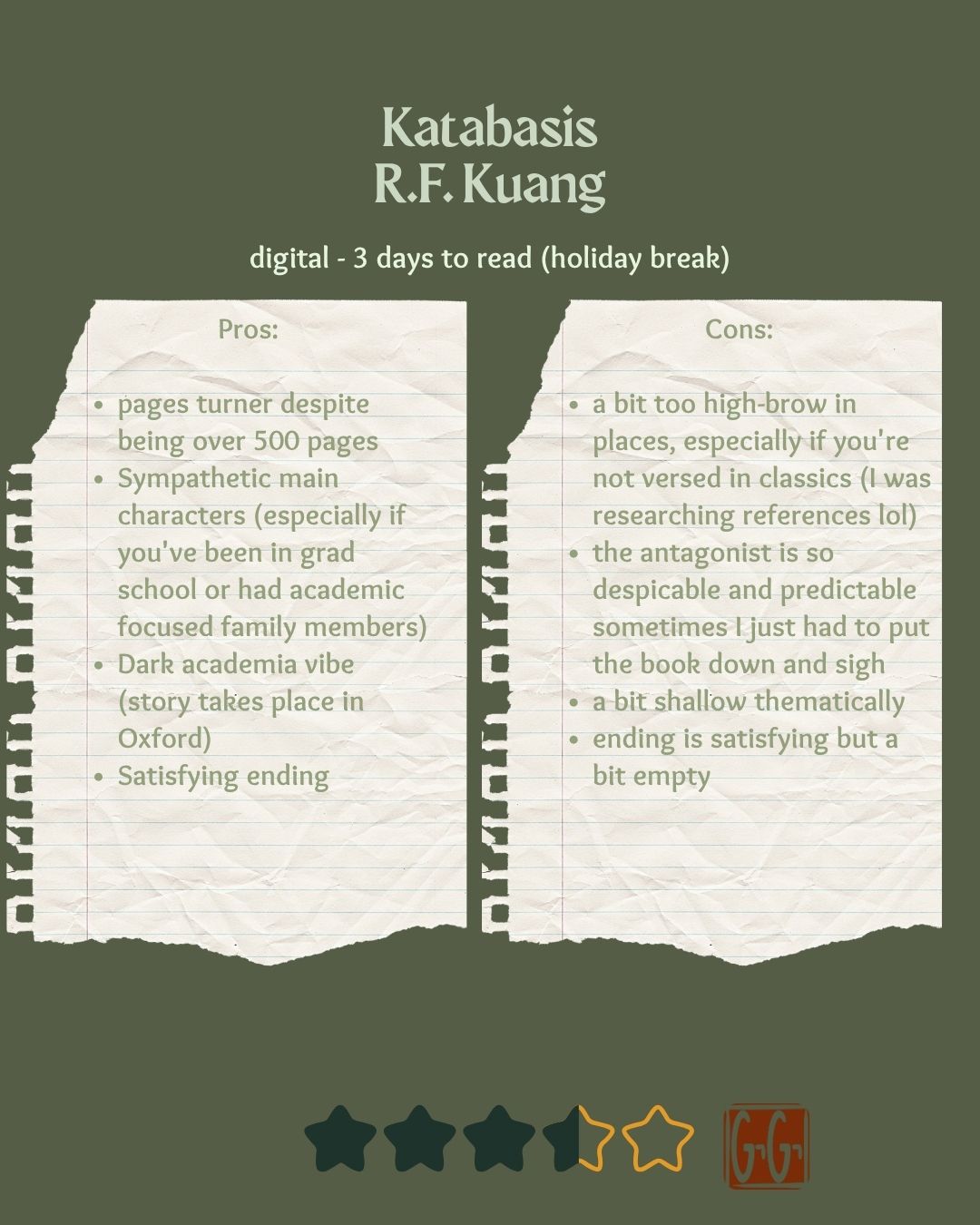
What I thought
Overall, I definitely liked the book (I read it in record speed), but I couldn’t help but feel that it was a bit lackluster compared to Babel and Yellowface, two of the author’s other works. I really hope to see a follow-up to Babel sometime soon!